

Shouting at Clouds
At Powerhouse Venture Partners, we are sometimes prone to being grumpy old men, shouting at clouds. Lately, some large, fluffy new clouds (the kids call them “neoclouds”) have come into our sight, and we’ve been triggered to shout at them. The kids tell us to sit down. And we do. But then, we take another glimpse up to the sky and we double blink as we think we see an angel falling from the sky.
In bond markets, a “fallen angel” is a company whose debt has been cut from investment grade to junk. In July, S&P downgraded Oracle (the database giant turned AI cloud developer) from BBB to BBB-, the shitty side of investment grade, because of its AI infrastructure capex and OpenAI concentration. Then in late September, Oracle sent a force majeure notice on the 2.45 gigawatts data centre in New Mexico, preserving the right to delay payments if the site misses its 2028 target. The trigger was power: state regulators have held up the gas pipeline needed to fuel the site, and an air-quality permit for its gas fuel cells is still pending. To many, these “acts of government” are (and were) predictable and therefore raises a question mark.
AI Market – A Perspective
We think the equity market has lost a little perspective on the equity value of LLM tokens – that it has too hastily assumed a token maxing proposition where the LLMs deliver ubiquitous, supra-national, agentic, super intelligence.
For the sake of our argument, let’s call tokens, “tulips” – just so no tokens get offended and release a life-threatening bot attack against us. And let’s call GPU’s “tulip pots”. And let’s call gigawatt scale AI factories, “tulip hothouses”.
Even though we are grumpy, we do truly generally admire tulips. They have a value and we like to buy them for our own house. We like the new breeds with all the different names; they seem to have a greater fidelity of colours in their petals. We are just happily going along with the crowd, keeping up with the Jones’, and not thinking too hard about cost or security. So far, the prices we pay for our tulips haven’t gone up. We have, however, started to hear about cheaper tulips on Temu. That’s making us a little curious.[1]
Meanwhile, the guy that makes the tulip pots has the ear of the king of the free world and is running around telling everyone that there is a desperate shortage (just like there was for other types of pots during the recent pandemic; and just like there was for the fancy pots from Korea with specialised capacity to remind the roots where to go). Everyone has been rushing around buying as many of these tulip pots years in advance of actually ever planting a tulip in them. We are curious about the perceived urgency in securing the supply of these particular tulip pots. After all, there’s quite a few pots to choose from and other people are now making different pots that will probably grow colourful tulips just as well, if not better. Indeed, the tulips from Temu aren’t grown in special pots. The American pot supplier is a really likeable guy, though, and everyone keeps buying from him. No-one notices that he’s now wearing a snakeskin jacket.
…AWS has to lay out cash for land, power, buildings, chips, servers and networking gear in advance of when we can monetize it, typically 6 to 24 months before we start billing customers depending on the component. — CEO Andy Jassy on Amazon’s Q1 2026 earnings call from April
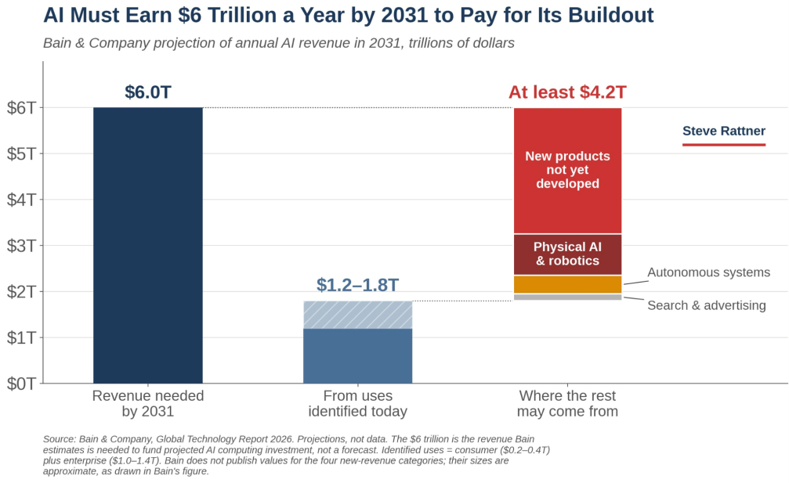
If AI products and services remain mainly a productivity tool, that market stays capped at roughly $250 billion according to NYU’s Professor Damodaran.[2] This is because companies only pay for productivity on top of wages. The multitrillion-dollar opportunity appears only if AI replaces expensive workers across industries and countries.
Cloud Watching & Forecasting
The bull case for neoclouds is simple: in the global AI mega trend, they are the main matches of a burgeoning demand against a scarce supply. For those stocks taking a high current year P/E from the equity market, two factors should be in place:
- the earnings growth appears durable (not the bear accusation that they have peak-cycle earnings boosted by accounting and/or by demand that the GPU and Token sellers have funded themselves).
- Given the level of leverage – the amortization of the loans will be faster than the depreciation of the assets securing the loans.
There’s lots of commentary on the debt aspects of what’s going on. We will therefore limit our focus to the first condition. Our worry for the earning growth durability for neoclouds is that AI (unless and until it becomes more than an enterprise productivity tool) will be squeezed from a few angles. Firstly, we think the most sensitive token usage of enterprises will be insourced. Secondly, a good chunk of whatever does stay in the cloud will be pushed into gold standard assurance – the hyperscalers and niche secured cloud providers – as part of a sovereign AI policy and security of critical infrastructure (tokens are good at coding cyber-attacks, nations will care about that). Third, the future of compute will be hybrid in more ways than we currently imagine, given quantum and the need for fast co-ordination at the edge.
MARKET TRENDS – TOKENS
• On a particular AI Gateway (called “Vercel”), open-weight models overtook closed models in August and hit a record 78.4 per cent of daily token volume in September.[3]
• Self-hosting open-weight models now costs under ten cents per million tokens.[4]
• Google’s new Gemini 4 Argon model tops many LLM benchmarks, but Bloomberg reports some Google employees found it struggles when put to real work, particularly coding – a claim Google disputes.[5]
• The labs’ revenue is, in large part, hyperscaler spending recycled – cloud credits, compute commitments, equity-funded consumption.
MARKET TRENDS – GPUs
• Spot market rental prices for older processors like the Nvidia H100 have plunged as AI hosts face oversupply in that usage.[6]
• Stabilisation of the overall packaging supply–demand deficit expected to narrow from roughly 20 per cent to 10 per cent by the end of 2026.[7]
• According to market expert, Ed Zitron, around 50% of sold AI Chips/Hardware are probably just sitting in Warehouses.[8]
• Nvidia’s revenue is hyperscaler capex.
MARKET TRENDS – NEOCLOUDS
• 93 per cent of 203 enterprise IT leaders surveyed in February have either repatriated AI workloads from public cloud, are doing so, or are evaluating it, and 91 per cent now default to on-premises, private or hybrid for anything sensitive.[9]
• Many expert reports rate data centre builds as a 1 in 3 chance: for ~ 500 gigawatts of announced data-centre projects only ~130 will get built.[10]
• Between 2008 and 2022, Microsoft, Google, Amazon, Meta, and Oracle had issued around $305.6 billion in bonds. Between 2023 and 2026 so far, they’ve issued around $374.5 billion. Hyperscaler capex in this cycle is not primarily a response to AI demand. To a substantial degree, it is the demand.
If any of my $500,000 engineers did not consume at least $250,000 worth of tokens, I am going to be deeply alarmed. — Nvidia CEO Jensen Huang on the All-In Podcast, recorded at GTC 2026 in March
Be alarmed, Jensen.
Already, enterprises are starting to steer sensitive work to self-hosted models, and government agencies are post-training frontier models in air-gapped environments (think Nvidia–Palantir) so they get to keep the weights.[11] Hedge funds are also starting to bypass neoclouds as well – Jane Street is building and financing its own 100–200 megawatt data centre,[12] and Hudson River Trading already runs its own.[13] The hardware trends seem to be heading the same way. You can buy from Bunnings Marketplace, Nvidia desktop systems for running and fine-tuning large models locally. Microsoft and Apple are seeking to run AI tasks on their devices first, sending only the harder ones to cloud.
Wrapping up
In the history of enterprise productivity, the intelligence layer (including when humans had that) was not normally rented or outsourced or allowed to work from home. It’s always been near the water-cooler. Indeed, cloud computing itself is actually a recent phenomenon.[14]
The bursting of market bubbles is usually restorative. The Dotcom crash didn’t kill the internet. It cleared out the speculation and pushed capital towards businesses that actually made sense. Amazon’s share price fell more than 90 per cent, yet it came out the other side leaner and went on to build AWS. The telcos that overbuilt fibre went broke, but the cables stayed in the ground, and that cheap, oversupplied bandwidth became the plumbing for Google, YouTube and, eventually, the cloud itself. Someone else paid for the hothouses, and the next generation got to plant the seeds for new tulips. If parts of the neocloud trade deflate, we expect the same: the GPUs, power connections and data centres won’t vanish – they’ll be repriced and end up with the people who can put them to enduring productive use.

| [1] We acknowledge that LLM tokens are very useful for vibe coding, cyber, and back casting on a data corpus (token usage for which the models are becoming increasingly efficient). [2] Aswath Damodaran (NYU Stern), Musings on Markets blog, August 2026, on AI valuations: estimates the current AI products and services market at roughly $250 billion, and calculates that Anthropic would need about $1.2 trillion in year-10 revenue to justify a $2 trillion valuation. As reported by Benzinga, “Amazon-Backed Anthropic Needs $1.2 Trillion in Revenue to Justify $2 Trillion Valuation, ‘Dean of Valuation’ Says,” August 2026, https://www.benzinga.com/markets/prediction-markets/26/08/61354241/anthropic-2-trillion-valuation-revenue. [3] Guillermo Rauch (Vercel founder/CEO), posts on X and Vercel AI Gateway leaderboard data: open-weight models reached 53.9% of gateway token volume on 11 August 2026 (vs 46.1% closed), rising to a reported 78.4% on 19 September 2026. Figures describe Vercel’s own AI Gateway traffic, not total AI market volume. [4] All-In Podcast, “Anthropic IPO At Risk, Meta’s Muse Pop, Token Prices Fall, Open Source Gains Share, Alignment Fails,” September 2026 – discussion among Chamath Palihapitiya, David Sacks, David Friedberg and Jason Calacanis on open-weight token share, model-layer bifurcation, self-hosting costs, and enterprise AI sovereignty. [5] Bloomberg, 30 September 2026, citing people familiar with Google’s internal evaluations: Gemini 4 Argon performs strongly on industry benchmarks but some employees found it inconsistent on practical coding and front-end tasks. Google told Bloomberg it “would be inaccurate to say that Gemini 4 is underperforming in areas such as coding.” Also reported by CNBC, 1 October 2026. [6] Andjela Radmilac, “Plunging GPU prices threaten AI hosts, and new hedges step in,” CryptoSlate, 3 October 2026, https://cryptoslate.com/plunging-gpu-prices-threaten-ai-hosts-and-new-hedges-step-in/. Covers falling GPU rental rates squeezing debt-financed GPU owners, CME Group’s planned H100 and B200 rental-index futures (with Silicon Data), and Luxor’s early-stage AI compute derivatives. [7] Spheron, “GPU Shortage 2026: How to Secure AI Compute When GPUs Are Sold Out,” 17 September 2026, https://www.spheron.network/blog/gpu-shortage-2026/. Cites analyst expectations that the CoWoS supply–demand gap will narrow from roughly 20% to 10% by end of 2026, with Rubin absorbing much of the new capacity. Spheron is a GPU cloud provider. [8] Ed Zitron, Where’s Your Ed At (newsletter), https://www.wheresyoured.at/. Source of the estimate that NVIDIA and Broadcom have sold around $561.5 billion of AI chips and hardware since the start of 2023, roughly half of which is sitting in warehouses rather than installed. [9] Cloudian, “Enterprise AI Infrastructure Survey 2026,” commissioned survey of 203 enterprise IT decision-makers conducted via Centiment, February 2026. [10] Bernstein, Madison Rezaei, August 2026, “Data Center Pipeline Probabilities: Separating the credible developers from dudes with PowerPoints” — 135GW of 492GW rated credible. Wood Mackenzie, 2026 estimate of US utility/grid operator commitments against 1,066GW of requested data-centre capacity. Rapidan Energy Group, Glenn Schwartz, 2026 estimate. Rystad Energy, 2026 grid-application credibility ratings, PJM and ERCOT (Texas) interconnection queues. [11] All-In Podcast, “Anthropic IPO At Risk, Meta’s Muse Pop, Token Prices Fall, Open Source Gains Share, Alignment Fails,” September 2026 — discussion among Chamath Palihapitiya, David Sacks, David Friedberg and Jason Calacanis on open-weight token share, model-layer bifurcation, self-hosting costs, and enterprise AI sovereignty. [12] Bloomberg, 4 June 2026, “Jane Street Plans New Data Center as Compute Power Runs Scarce.” [13] Hudson River Trading operates its own data centre for internal model training on proprietary market data, as separately reported alongside the Jane Street story. [14] AWS rented out its first server in 2006. Some of us are old enough (and grumpy enough) to remember “on premises”: mainframes, localised servers and high performance computing centres. Amazon Web Services launched its first storage service (S3) in March 2006 and began renting out virtual servers through Elastic Compute Cloud (EC2) in August 2006 – the same month Google CEO Eric Schmidt popularised the term “cloud computing”. Before that, enterprises ran their own mainframes (shared via time-sharing from the 1960s), then client–server networks and on-premises data centres through the 1980s and 1990s. |
| Disclaimer: This blogpost is for informational purposes only, it does not constitute investment or financial advice. Nothing here constitutes an investment offering of any kind, unless expressly stated. Before acting on any information contained in this blogpost, each person should obtain independent taxation, financial and legal advice relating to this information and consider it carefully before making any decision or recommendation. The Powerhouse Group of Companies holds an Australian financial services licence (AFSL# 497505) and may have a shareholding in some companies discussed. Visit our website to read our privacy policy. |