
Diamonds are a grid’s best friend |
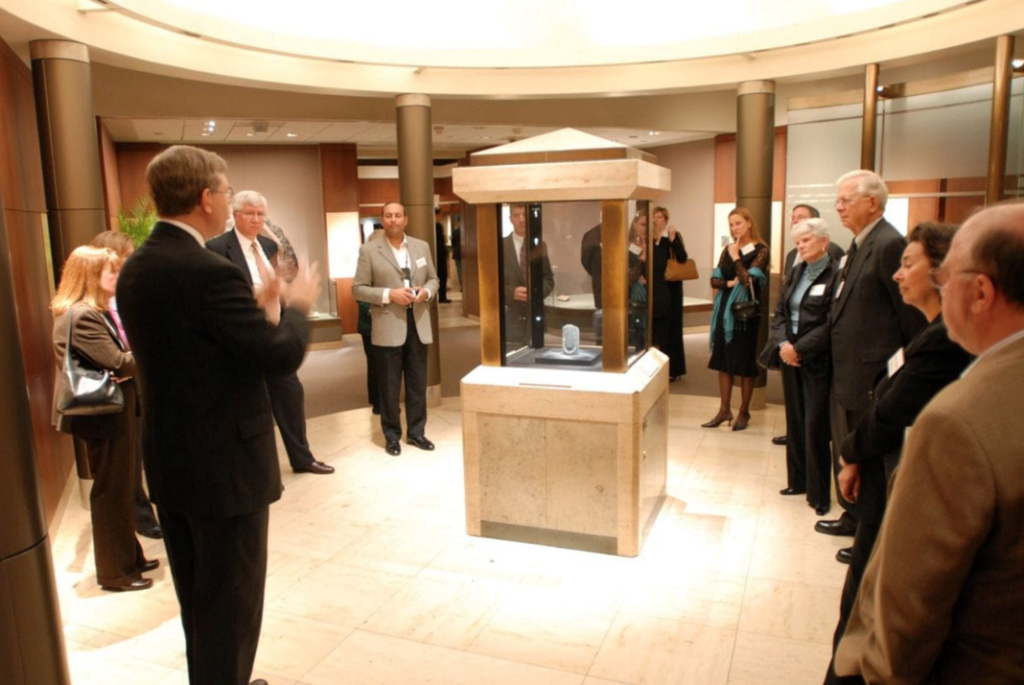
| The Hope Diamond is said to have cursed everyone who came near it, Louis XVI and Marie Antoinette included. Its deep blue colour is quantum-mechanical: inside the diamond, one carbon atom in every million was replaced by a boron atom. The boron atom acts as an electron acceptor, absorbing the red end of the visible spectrum and letting blue through. Under ultraviolet light the Hope Diamond phosphoresces red for close to a minute afterwards. Spooky quantum things, at no distance at all.Insulation around electrical wiring degrades slowly. Tiny electrical breakdowns at weak points, known as partial discharge (PD), recur and intensify over days, months and years until they eventually cause a short or a fire. Grids, defence platforms, vehicles and aircraft all carry a lot of ageing wiring, and therefore a lot of accumulating PD risk. The trouble is that the PD signal is faint and sits right next to a loud AC current, which normally drowns it out.
Diamond is one of the more credible answers to this problem. Nitrogen-vacancy (NV) centres (a missing carbon atom sitting beside a nitrogen impurity) give diamond an unusually wide dynamic range as a sensor. Scientists have demonstrated an NV-diamond current sensor with enough dynamic range to track electric-vehicle battery currents from milliamps to hundreds of amps. Utilities in China have already begun piloting quantum PD sensors at live substations. In June this year, the US electricity sector’s research body set out its own “Quantum Sensor Ambitions” for exactly this kind of grid-monitoring gap. We rely on a growing variety of sensors to notice little changes: in position, in a field, in vibration, in the onset of a fault. Across distributed, mass-deployable hardware (position, navigation and timing for autonomous systems and robotics; monitoring and protection of physical assets and critical infrastructure) this is a fast-growing addressable market. Sensing is where quantum technology will be making money soon, ahead of quantum computing. Start-ups around the world – our portfolio company, Quantum Brilliance, among them – are working to package NV-diamond sensing into smaller, cheaper, lower-power form factors than earlier lab demonstrations required. This is exactly the shift that turns a spooky physics into a shippable product. |
Market Watch – Google’s Capex |
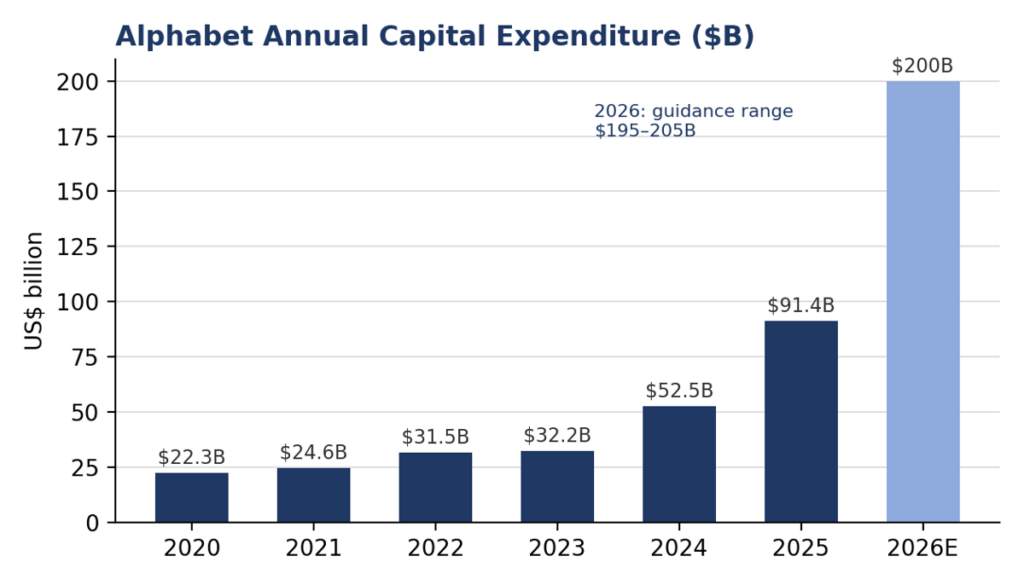
Google went cashflow negative for the first time since the company went public in 2004. Despite Q2 revenue increasing 24% YoY to US$119.8 billion and operating income up 30% to US$40.8 billion. Put the capex number in context: at the top of its raised guidance, Google will spend roughly 20% of this year’s entire US military budget on capex alone.
They spent US$44.9 billion on capex in the last quarter alone, roughly double what it spent a year earlier. Full-year guidance has been raised again, from US$180 to 190 billion up to US$195 to 205 billion, and management has already flagged that 2027 will be higher still.
While there are fears of circular financing, unlike almost every other hyperscaler, Google isn’t fully hostage to Nvidia’s GPU queue. They have their own Tensor Processing Units (and also with a fair share of electricity generation capability and maths nerds – refer our previous edition on AI). We believe the market will have longer patience with Google’s negative free cash flows as a consequence.
| Sovereign Watch – Who Regulates AI? |
Jensen Huang used his first-ever post on X to share an open letter signed by 25 companies, including Microsoft, Meta, Palantir and Hugging Face, arguing against premature restrictions on open-weight AI models. The letter’s framing is explicitly sovereign: open models, it argues, built the shared foundation behind decades of American software leadership, and the same logic should now apply to AI, particularly with Chinese open-weight models like Kimi K3 closing the gap.
In the same week, Google DeepMind’s Demis Hassabis has proposed a FINRA-style self-regulatory organisation (SRO) for frontier AI models: an industry body, not a new government agency, that would test and certify the handful of models that actually represent a step change in capability.
We support both positions. Having worked with FINRA for over 20 years, the SRO model is only effective under three key pillars. First, the assessed and the assessor have experience in designing compliance features in real world contexts (FINRA’s own examiners and rule writers come out of broker-dealers themselves). Second, the mandate has to stay narrow and resist scope creep. In AI, we believe the imperative is to focus on catastrophic risks only: cyber and CBRN (chemical, biological, radiological, nuclear), and stay well clear of disinformation or other lesser harms. Third, it has to genuinely substitute for a new regulator rather than sit on top of one (FINRA membership replaces separate state-by-state broker-dealer registration, it does not add to it).

| Disclaimer: This blogpost is for informational purposes only, it does not constitute investment or financial advice. Nothing here constitutes an investment offering of any kind, unless expressly stated. Before acting on any information contained in this blogpost, each person should obtain independent taxation, financial and legal advice relating to this information and consider it carefully before making any decision or recommendation. The Powerhouse Group of Companies holds an Australian financial services licence (AFSL# 497505) and may have a shareholding in some companies discussed. Visit our website to read our privacy policy. |