

Tech Watch – Made True Blue
Mother Nature wrote a memo about the colour blue: “Don’t try this at home, kids”. And all the Peacocks, the Blue Wrens, and even the blue-eyed Vikings gathered around to read it.
Almost no animal in nature is actually the blue pigment. It’s metabolically awkward to make. Evolution therefore hacked “blueness” from the nanostructure of the cells: microscopic ridges and layers that tune the wavelength of light and reflect only the blue back. The Olivewing butterfly in South America didn’t get the memo – it is actually made true blue.
For hundreds of years, humans have coloured metal the exotic hard way – spraying pigment suspended in solvent onto a surface, then baking it on in an oven at high heat. It’s slow, it’s energy-intensive, and it’s dirty: paint shops are among the largest sources of volatile organic compound emissions and fire risk. If only we read the memo.
This is the place of material science. For example, Cirrus Materials in New Zealand (a large portfolio position of ours), does to aluminium what Mother Nature already did to feathers, and wings, and eyes. It grows a nanoporous structure directly on the metal’s surface, tuned precisely enough to produce an accurate, consistent colour purely through the physics of reflected light. No pigment, no paint, no oven: the colour is plated on at ambient temperature in a closed-loop system, cutting out the emissions, the bake-cure energy load, and the fire hazard that come with a conventional paint line. Automotive is the obvious first customer, but the same approach applies anywhere a surface needs durable, precise colour – aerospace, electronics, energy and heavy industry.
Across the ocean in Australia, is a company we admire (but have not had the opportunity to invest) called Mako which drew inspiration from Sharks and their skin. Microscopic grooves channel water flow along a shark’s body rather preventing turbulence and drag. Mako is printing this same groove pattern into thin films for aircraft and delivering potential fuel savings of up to 4%.
It’s a nice reminder that the “high-tech” answer and the natural one are often aligned.
Market Watch – Pax Americana is now Lax Americana?
We have our discerning eyes on this: whether the end of Pax Americana shows up in market structures, in asset pricing and in how capital gets allocated. The standard rebuttal is “don’t forget American Exceptionalism” – that everything is, and, will remain, awesome. The deep capital markets, the (arguably excessive) meritocracy, the generational constitutional freedoms, the pull on global talent, the world-class universities, and the blessed geography all combine to greatness.
One structural point, though, which goes to the capacity to absorb debt and ultimately whether US Exceptionalism sustains asset prices. We need to resist the instinct to read Nations’ debt ratios and simply stop there. On that instinct, and picking on Japan, it looks terminal whereas the US looks merely stretched. [1] Judging on pure arithmetic the US is comfortably the stronger sovereign. But, estimating the willingness to actually deliver a fiscal adjustment, we’re less sure.
Ultimately, capacity to repay sovereign debt is a question of whether a society will consent to the taxes and the restraint that repayment requires. This comes back to institutional trust and social cohesion, not raw arithmetic. Japan is a high-trust, demographically homogeneous polity with a fiscal settlement its citizens largely fund themselves. The US is different. We all painfully hear about its divided federalism and a polarised legislature; the debt ceiling is one manifestation of a recurring brinkmanship.
On 19 August, Treasury Secretary Bessent doubled the size of the Treasury’s long-bond buyback operations after the 30-year yield hit its highest level since 2007 – a direct intervention to prop up demand for US debt that the market wasn’t supplying on its own.
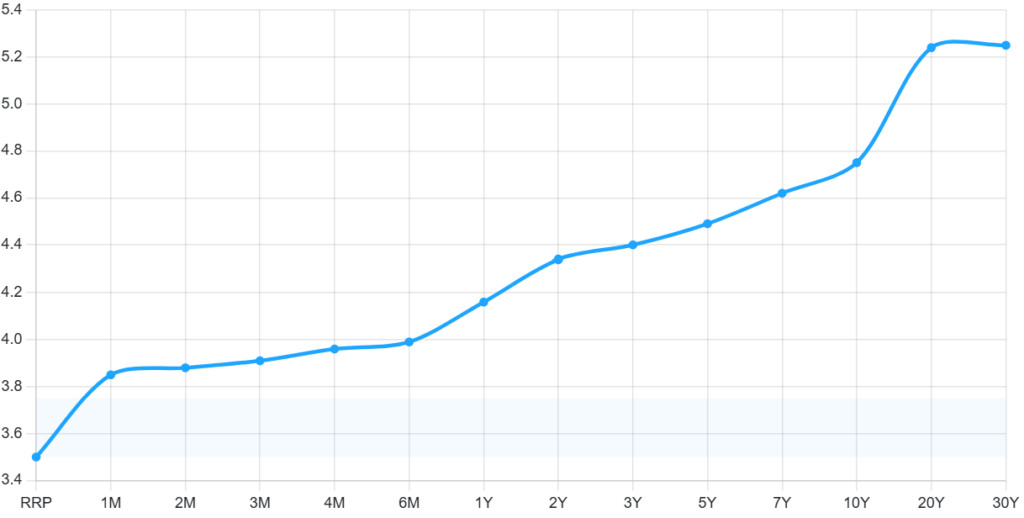
US Treasury yield curve 31/08/2026
Far from abandoning US exposure, we’ll scrutinise assets still priced on the ‘US default’ assumption. Positions sized on the old assumption that American assets carry no country-risk premium deserve a second look, and the widening opportunity set offshore – from Korean tech to European defence and banking – is worth weighing on its own merits. There is more value out there than the old rationale of: US + a hedge against the US.
Sovereign Watch – Europe’s Coming Defence Primes
US venture capital has won every race it has entered. They are truly exceptional – just ask them.
In defence specifically, Palantir is the public market’s proof point. Anduril isn’t listed yet, but it’s sitting on a roughly US$61 billion private valuation and openly angling for an IPO.
But there’s a real war in Ukraine, and European firms are putting live production onto that battlefront, not just prototypes: Quantum Systems‘ reconnaissance drones have flown there since 2022 (500-plus delivered) and now sell to the US Army; Helsing raised US$1.8 billion in July and is building its first American factory, in West Virginia; Tekever‘s long-endurance drones, proven over the Black Sea, are drawing interest as far as Taiwan.
Europe should not be dismissed as a Museum. As much as Trump would like to think US military kit is the only stuff on the market, we think European deep tech players will start to emerge.

| [1] We’d argue these sorts of ratio are the least informative number in the frame. Japan carries roughly 250% gross debt to GDP and still funds itself cheaply; strip out the government’s own financial assets and net debt is closer to 134%, against 97% for the US. The gap is a fraction of what the headline suggests. What differs more is who holds the paper and why they keep holding it: around 85% of Japanese government debt sits with domestic investors, and the ultimate owners are thrifty domestic savers rather than foreign institutions and central banks that can reallocate at speed. The Bank of Japan holds close to half of all outstanding JGBs; the Federal Reserve holds only around 15% of US debt held by the public. |
| Disclaimer: This blogpot is for informational purposes only, it does not constitute investment or financial advice. Nothing here constitutes an investment offering of any kind, unless expressly stated. Before acting on any information contained in this blogpost, each person should obtain independent taxation, financial and legal advice relating to this information and consider it carefully before making any decision or recommendation. The Powerhouse Group of Companies holds an Australian financial services licence (AFSL# 497505) and may have a shareholding in some companies discussed. Visit our website to read our privacy policy. |